
The Emerging Economic Geography Between Europe and Asia: Azerbaijan and Latvia’s Strategic Role
The reconfiguration of logistics routes is directly influencing Latvia’s competitiveness and international trade prospects. Those businesses capable of adapting to the new realities of logistics and export markets will gain a strategic advantage. Current geopolitical developments are compelling Europe to seek new connectivity routes with Asia, and in this context, Azerbaijan is gradually emerging as one of the region’s most important logistical and economic hubs.
Periods of geopolitical transformation often create opportunities for smaller and more agile states to assume roles far greater than their geographical size might suggest. Modern history offers a well-known example in Singapore, which over the course of fifty years evolved from a small fishing settlement facing significant external security risks into a global centre for trade, finance and logistics. Similarly, the Netherlands established itself as one of Europe’s leading trade hubs by combining port infrastructure, an internationally oriented business environment and the ability to connect different regions and business cultures.
Comparable trends are becoming increasingly visible across the Caspian region, where Azerbaijan is strengthening its position between Europe and Central Asia through the development of industrial parks, the growing strategic importance of the Trans-Caspian International Transport Route-commonly referred to as the Middle Corridor-and a steadily expanding role in international politics and economic diplomacy. International discussions have also increasingly touched upon the so-called “Trump Corridor” as a potential alternative connectivity axis between Europe and Central Asia. Regardless of how these initiatives develop in practice, the discussions themselves point towards a broader trend: the Caspian region and the Middle Corridor are gradually becoming part of a new economic geography linking Europe and Asia.
Within this context, cooperation prospects between Latvia and Azerbaijan are developing in two directions simultaneously-Azerbaijan as a gateway to Asia, and Latvia as a gateway to the Baltic and Scandinavian markets. The relationship between the two countries is further strengthened by long-standing diplomatic ties and a historically established mutual understanding.
Recently, Latvia and Azerbaijan marked the 30th anniversary of diplomatic relations, a milestone that also reflects the gradual development of economic cooperation between the two countries. One of the key indicators is Latvia’s consistently positive export balance in both goods and services. Export dynamics over the past decade demonstrate a stable and sustained trajectory of bilateral economic cooperation. At the same time, the substance of the economic dialogue between both countries is evolving. Whereas cooperation in previous years was often associated with isolated trade initiatives, current trends increasingly point towards broader areas of engagement — logistics, digital solutions, sustainability projects, education, export of expertise, creative industries and the food sector. This direction was further reinforced during the recent Latvia–Azerbaijan Intergovernmental Commission meeting held in Shusha, where discussions focused not only on traditional sectors but also on emerging niches for economic cooperation.
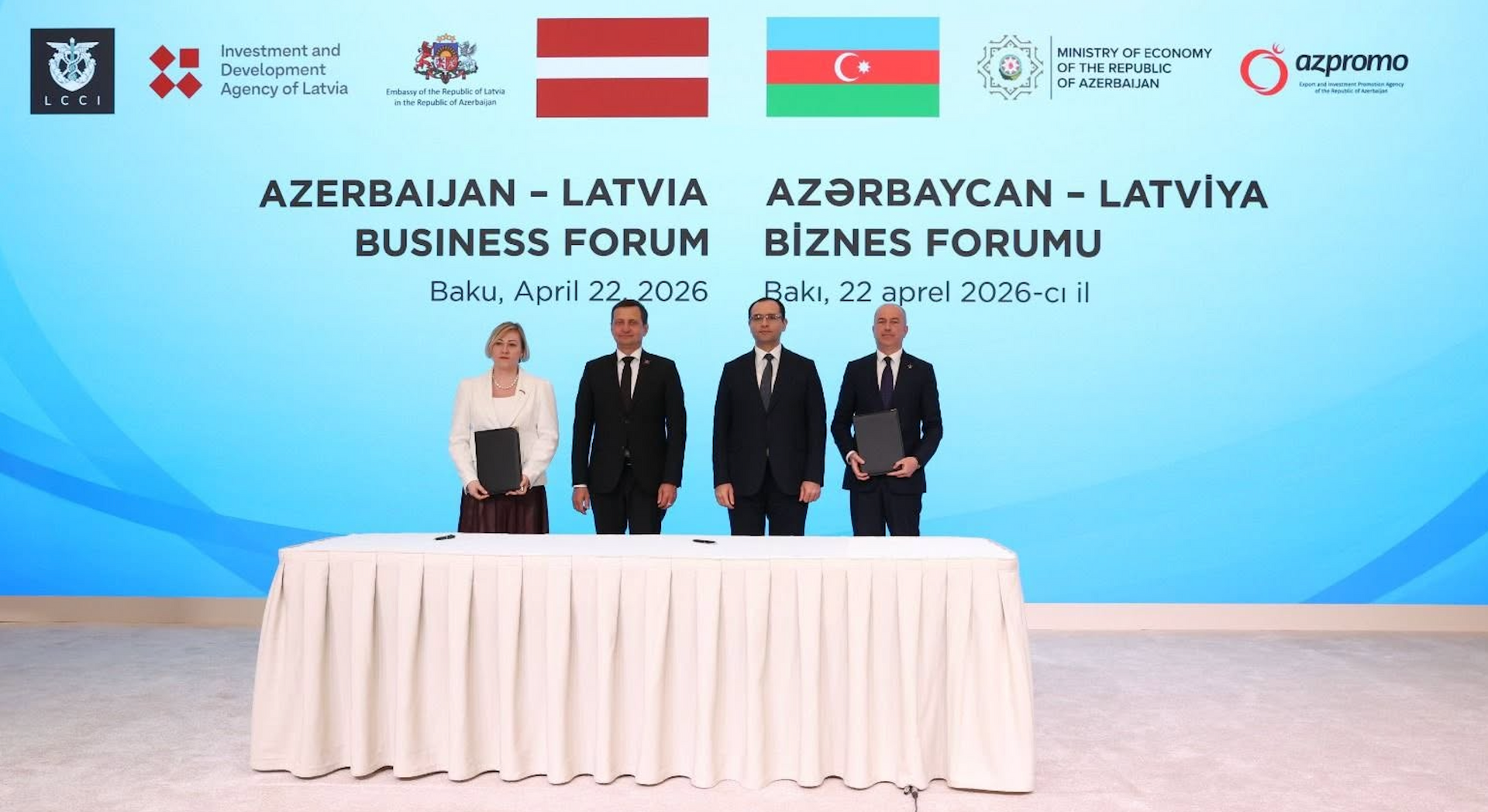
The growing economic and institutional dialogue between the two countries was also reflected in the April 2026 visit of the President of Latvia, Edgars Rinkēvičs, to Azerbaijan. During the visit, the Azerbaijan–Latvia Business Forum served as a platform for developing new partnerships and practical cooperation projects. At the same time, it highlighted increasing interest in Latvia as a potential connectivity and cooperation point for Northern Europe.
Another significant signal for the business environment was the signing of a cooperation agreement between PowerHouse Latvia and the Caspian Energy Club. Given that the organisation brings together leading Azerbaijani companies and international partners, such cooperation may serve as a practical support mechanism for Latvian businesses-ranging from market research and geopolitical risk assessment to the development of concrete business partnerships and projects.
The next strategic step for Latvian businesses is the ability to move beyond their traditional comfort zones. The new realities of international trade increasingly suggest that future growth opportunities will emerge outside familiar and predictable markets. In the context of Azerbaijan, it is particularly important for Latvian companies and organisations to understand both the market and the local business culture, while adopting a consistent, long-term approach to partnership building.
Successful cooperation in the region also depends on sustained local presence and the ability to build trust within the business environment. Equally important is the distinction between geopolitical risks and broader policy analysis, as international political developments may directly influence economic cooperation between the two countries.
As the global economy continues to reorganise itself, Latvia also has an opportunity to evolve from a peripheral market into a hub of connectivity between the Baltic region, the Caucasus and Central Asia. In this changing environment, success will depend not on the size of a country, but on its ability to build partnerships in a timely manner, understand regional transformations and establish a presence within the emerging centres of economic growth.
Līga Sičeva
Partner & Director of International cooperation
Analytics and Advisory group “PowerHouse Latvia”